
I finally caught a dear friend at RISC (Research Institute for Symbolic Computation) and asked for some of his wisdom. He answered in his usual unique and sometimes convoluted way. I hope you’ll enjoy our conversation as much as I did.

I finally caught a dear friend at RISC (Research Institute for Symbolic Computation) and asked for some of his wisdom. He answered in his usual unique and sometimes convoluted way. I hope you’ll enjoy our conversation as much as I did.

I get to catch up with a long-time friend in Linz, of all places. He was always someone to look up to since my graduate student years. I am happy to finally get to have a deep chat about some aspects of academic life with him.
Unfortunately, my camera died, and we didn’t get to record the last two minutes. We will keep those secrets for another day. Nevertheless, I hope you will enjoy the (incomplete) chat we had as much as I did. We will complete our conversation some other time.

I was lucky to catch up with Ilias. This meeting being in Crete during the Applications of Computer Algebra (ACA) was an added bonus of course. It has been a long time since we last saw each other in person.
We talked about various things. The main one being the ACA 2025 and the 30 years of this conference. Hope you will enjoy our chat as much as I did.
(Sorry for my mic, but I am glad Ilias’ mic worked perfectly.)

I recently had the privilege of working on an interdisciplinary project. My coauthor, Michael, and I struggled to understand each other at first, but it became a fun project once the translations and goals were all set. Here is the published paper at JSC: https://www.sciencedirect.com/science/article/abs/pii/S0747717125000380, and here is my take on our collaboration at the Future Algorithms conference:
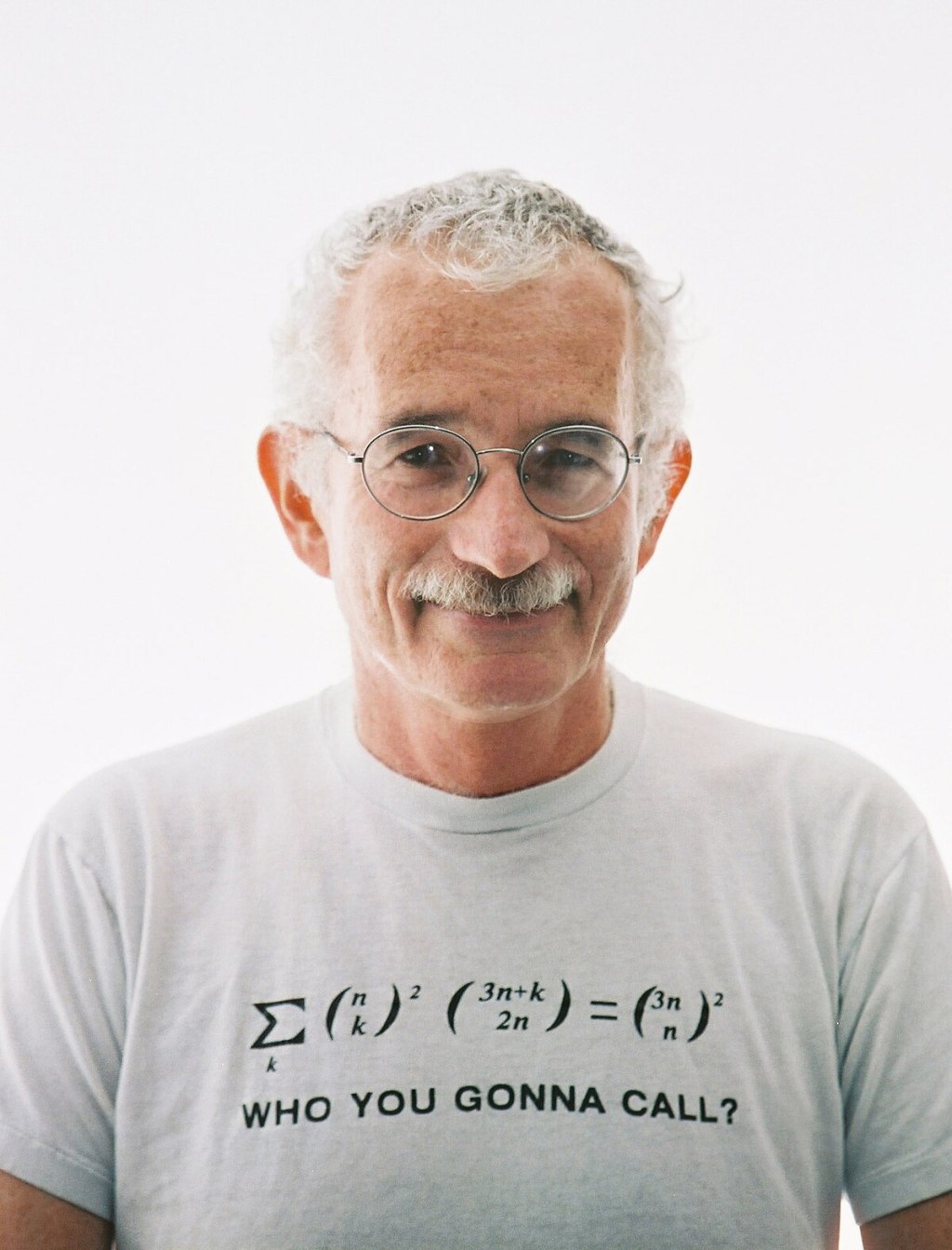
Join me in this conversation with Doron Zeilberger. He is among the book’s authors literally called A=B, and if you ever want to prove some A=B on a computer you’ll quickly find his name.
I always enjoyed our conversations since I first met him in 2016 at JMM, and I am so happy to finally ask some questions I had for him on record.

“Lange Nacht der Forschung” (Long Night of Research) is an Austria-wide inspiring bi-annual event that showcases the world of science and innovation to the public. Each institute and university holds events for one night after work hours all across Austria to meet the public and talk about their research. What questions are they asking? How is the research being conducted? Why is it important/interesting? What led the researchers to where they are? It is a celebration of knowledge. It bridges researchers and the broader community. It allows researchers to get out of their offices and labs for once and engage with people of all ages.
The Austrian Academy of Sciences asked the Johann Radon Institute’s contribution to this event. We were asked if we would like to spend one evening in Vienna at the Academy’s historic building and talk about some mathematics of our choice. I figured that this would be my last chance to join this event before my project ends at the Radon Institute and I volunteered to be a part of it. It was highly rewarding.
Outreach of mathematics is already difficult even when the knowledge level is given. Even between mathematicians, it is hard to understand the research of one another. Mathematicians specialize in difficult problems and end up joining the clique that is interested in similar questions. Each clique, over time, creates its own mathematics vocabulary, definitions, known results, lectures, and books; further making it hard to have a casual conversation on these abstract topics with history.
I would have loved to talk about integer partitions and q-series, but I made the stylistic choice and prepared some material on real quantifier elimination (what I have been working on in the project at the University of Bath). It offers more direct applications to everyday life, and I figured that would be easier to connect to people. Autonomous vehicles are a hot topic these days and the question “Computer, make sure these vehicle trajectories do not intersect” to avoid any collusion is a quantifier elimination problem when it is written in mathematics language.
Johann Radon Institute for Computational and Applied Mathematics room at this event was diverse and lots of fun. Other than my desk, we had rigidity theory, machine learning, cryptography and prime numbers, and various medical imaging exhibits.
I chatted not only with the locals but also with some tourists visiting Vienna. It was eye-opening. It barely felt like I was talking about mathematics. It was so rare that someone asked me how we were achieving what I said was the end goal (collision avoidance). People only wanted to see some faces and hear their enthusiasm for the work that they were doing. I should remember this for the next time I try to explain my research to my family. They don’t want details, they just want to know that I am enthusiastic about what I do. Anyway, it wasn’t all empty PR. We got a visit from the University of Vienna Mathematics student cohort. They asked me many technical questions. It was only then I launched GeoGebra Discovery and Maple and played with some examples I prepared beforehand.

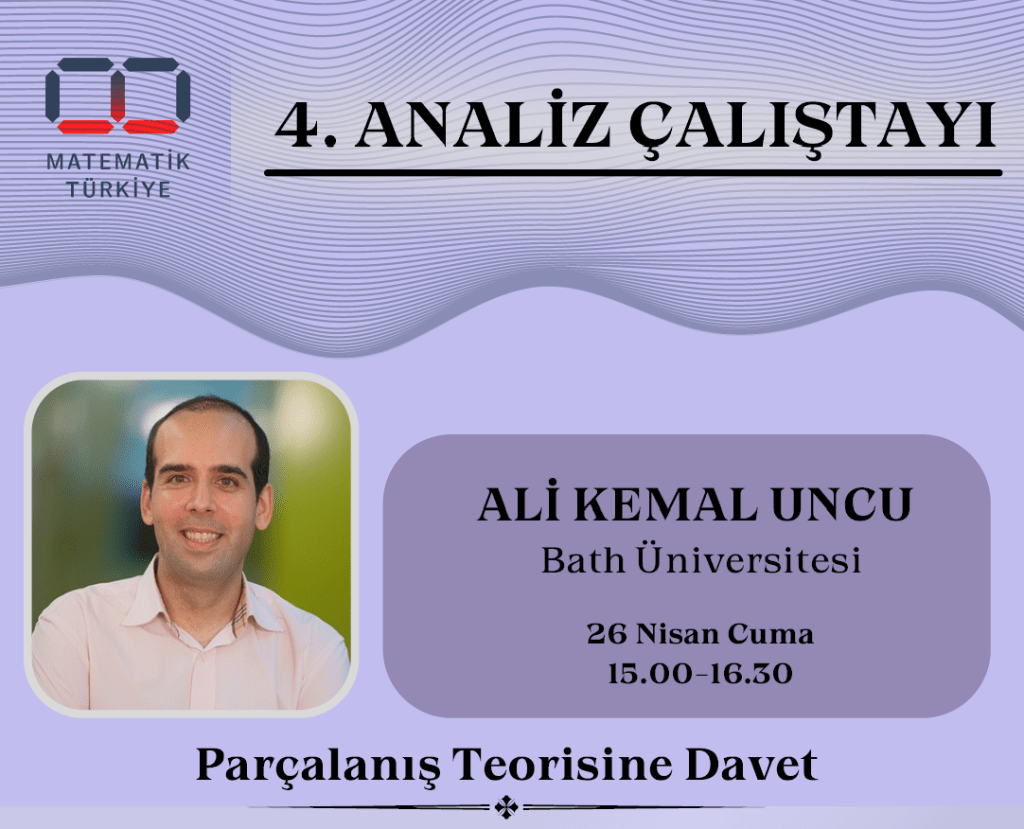
It is always lovely to interact with the math enthusiasts. Türkiye Mathematik is one of the most established and active groups these days. They helped the SCALE 22 conference and provided the conference volunteers, to run the organızatıon smoothly. I am so glad they asked me to give a plenary talk and I was honored to provide such a colloquium on a topic I love.
If you know Turkish, if you would like to hear some Turkish, if you would like to listen to me give a mathematics talk in Turkish, here is me giving a birds-eye view of the Theory of Partitions:
I hope many more of these clubs will form and spread the love towards academics. I will try my hardest to say yes whenever they ask me for help.

Here is the link to the article!
I am overjoyed to write a small article in the Turkish popular mathematics journal Matematik Dünyası (Eng. World of Mathematics). Of course the article is about integer partitions. It is actually called Parçalanış Teorisine Davet (Eng. An invitation to Theory of Partitions). I tried to give some overview of what common questions are asked in this field of study.
I purchased some volumes of this journal when I was an undergraduate student in Bilkent and while doing my first masters. This is no Sudoku magazine. You can compare it with the American Mathematical Monthly without the refereed papers. It always includes some heavy hitting articles and an extensive problem section (just like Amer. Math. Monthly). No shame in admitting that I always found some parts of this journal hard to read. They let active researchers write notes that they see fit for a general audience. Sometimes some of those articles stay a little too technical for me. Nevertheless, this journal is one of those things that kept the spark alive in me. I liked mathematics but I remember losing motivation here and there. Reading about peoples excitement about the mathematics they love was/is a great refresher even when I didn’t understand what was going on mathematically.
I hope that my article stays on the fun side. I taught a partition theory course just recently, I hope that helped in keeping things light. If it encourages anyone to read into partitions, that would be wonderful!
I want to thank Ümit Işlak for suggesting that I write something for Matemaik Dünyası. I also would like to thank the managing editor Olcay Coşkun and the Turkish language editors that helped me with the proofreading. Who could have known that writing something in my native language would be harder? Because I didn’t ever write math in it and don’t know the terminology, because I form many upside-down sentences (like Yoda, I wrote), etc.
It was a wonderful experience. Can’t wait to get the physical journal in my hands. Once the article becomes open access I’ll also put a copy of it here (which I did on 15/7/23). For now it is exclusive to Matematik Dünyası subscribers.

This is a research in teams event that will take place at Johann Radon Institute for Computational and Applied Mathematics (RICAM) of the Austrian Academy of Sciences (OEAW) and Research Institute for Symbolic Computation (RISC) of Johannes Kepler University (JKU). Some talks are announced below to introduce the problems and the state of the art.

This event is supported by Doktoral Program Computational Mathematics at JKU.
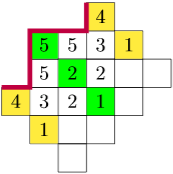
 . In this talk I will try to explain why cylindric partitions have become such a powerful combinatorial tool for discovering new identities of the Rogers–Ramanujan type.
 Bailey machinery, Andrews-Schilling-Warnaar discovered an
  generalization of the notion of Bailey pairs and the Bailey lemma. Using this, they discovered identities involving principal characters of standard
  modules. However, for every positive integral level l (barring a few low-lying cases), a majority of identities involving level l standard modules were yet to be discovered. In a recent joint work with Russell, we have given conjectures that encompass all of the missing identities. Especially, we can prove our conjectures in levels 3 and 7 (and also levels 2, 4, 5, but these cases are not exactly new). Our proofs crucially use the Corteel-Welsh recursions governing cylindric partitions. Using a different circle of ideas, we were also able to produce various results when the levels are divisible by 3. In this talk, I will explain these developments. Time permitting, I will touch upon some exciting open problems that still remain.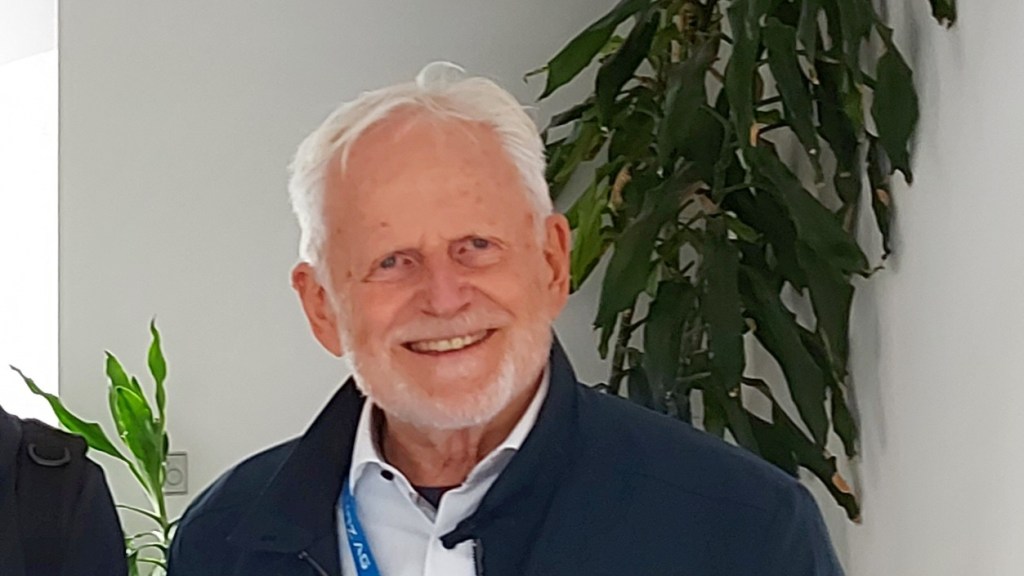
A legendary mathematician, amazing visionary, fun loving easy to chat overall nice person.
Bruno changes the game in everything he does. For example, we couldn’t stop at the 15 minute mark. It was an enjoyable conversation. I am glad we found the time.
