• I don’t believe anyone wants me to recap what is up these days (the numbers, the numbers are up) or why there would be a need for quarantining. So I’ll just jump into my mandatory quarantine days.

    March 1, 2021: Quarantine day 0

    I started this day fairly early. I actually did the Vienna to Bath part of my trip on this very day. So when I finally came to the University of Bath campus, there wasn’t much more of the day left. The evening was closing in when I finally got my keys and burrowed in my room at the Marlborough Court. I was the only occupant of a flat with 6 ensuite rooms and a shared kitchen. Perfect for quarantining.

    I made a video about this trip already: Here.

    The University’s quarantine team was already on top of everything. There was a microwave, a kettle, and a crate of food to last me the next 10 days. It was satisfactory, to say the least. Except, there wasn’t any crockery or cutleries. That was just an email to the quarantine away though. They responded really fast.

    I had a meeting with the HR representative to prove my identity and that I entered the UK. That took no more than 15 minutes. Right then and there, I became a new member of the University of Bath.

    March 2: Just settling in

    This was an eventless day really. The weather is not the greatest either. It was more about settling in and trying to list the things with respect to their urgency. I had my first meeting with, my new mentors, James H. Davenport and Russell Bradford. We had meetings before but this was the first time we were all in the same country. We mostly talked about the university and its structure.

    James sent out some emails to jump-start things for me. Next thing, I was getting bombarded by different offices of the University to get things done fast. I set up my university account, email, sent a request for a library card… and the day ended before you know.

    March 3: First test day

    Another foggy day with all grey skies. At least that’s what I can see from my dorm window. Nevertheless, this was an exciting day. I was going to self-administer my first test and send it back to NHS for testing. Of course, a negative result was desirable but this test will also show how the preventative measures I used held up against this virus.

    I opened a test kit. Nothing surprising was in there. A booklet, a swab, a tube with some saline solution, a bag, and a return box was all there is. I read the documentation, did the registration, and watched a video in which a doctor demonstrated the test. Let me tell you, he made it look so easy. My test experience was completely different. Swabbing my tonsils? Almost impossible. I didn’t know that I could show so much gag reflex. Swabbing my sinuses? I started sneezing uncontrollably. Anyway, the experience wasn’t the best but it made me appreciate how proficient the tester in Linz was once more. The young soldier that administered the test on me just made it look so easy.

    The university’s security picked the test from me later in the day. I kept on catching up with emails.

    March 4: I am negative

    Once again the day started all foggy, but there was some excitement going around on the campus. I saw more students going up and down the street and I think some students were moving into the building across from my dorm.

    The quarantine food pack came with some quite similar breakfast options. At least that is how I perceived it, maybe someone would have considered the frozen dinners as possible breakfasts too. I was given instant oatmeal or bar cereal with fruit yogurt. For the curious ones, I had milk. I would be okay with these options any day of the week but I noticed that I wanted something else, anything else today. I think it was quarantine creeping in.

    My test results came back negative later in the day. Another 5 days to the second test and this will be over.

    March 5: University training courses

    I got contacted by the Computer Science department admin about the department/university orientation among other things. I started with the departmental induction module. It was a fair amount of reading, especially if you are following the links and getting into the crevices of the site. It needs to be said that I am really impressed with how well put-together and organized this university is. The documentation is impeccable and there seems to be some reference document for every possible scenario.

    By pure chance, I saw that a friend was giving a talk on Facebook. I directly jumped on it and asked if I can join too. Next thing, I was in a math talk with all the top people in the field. I was so surprised that I didn’t hear about this seminar series before.

    At night the students threw what seems like a block party on the street in front of my window. I think they had a great time. I didn’t pay too much attention to them but I doubt there was much social distancing.

    March 6: A fire alarm chirp

    Bright day, chilly but sunny. A boring breakfast and a cup of coffee later, I am ready for the day.

    I continued going through the University’s induction information. Among many other things, I found a concrete set of mandatory training courses expected of me. I started with basically the easiest one, fire safety. I liked, the Windows 98 type, old interface this course had. This was actually true for all the online courses. They must have been prepared many years back but the information was still relevant. Why fix something that is not broken, right?

    In the afternoon, while I was chatting with my girlfriend, the fire alarm went off for a short time. The information was fresh in my mind, if only the alarm went off for a tad bit longer, I would have darted all the way out. It would have been a great excuse to stretch my legs a little.

    I figured that I have been eating rice one way or another for some number of days. Cup-noodle-like rice dishes, microwave rice, rice vermicelli… Suddenly the frozen dinners looked boring too.

    Another night of partying on the streets. These kids know how to have fun.

    March 7: Frustrations build

    Today I saw two new quarantine signs on doors in the apartment. Soon there will be some people here. One even got his commissary food box ready for their arrival on their doorstep. So far I was being careful but relaxed in the apartment but it became clear that more caution will be required around the kitchen from now on.

    I was completely bored with the food though. That was the real issue. I didn’t want to prepare something from the quarantine rations. It might have also been that I got really bored of the statical discharge shocking me every time I touched the microwave. I wanted something delivered. This plan failed horribly due to the food delivery service not liking my credit card’s zip code. I got a little frustrated with that but at least I still had food.

    To bribe my own morale, I decided to order some items from the online shop of the on-campus grocery store. I didn’t see this shop before, and I couldn’t wait to see it for myself. Their proportions of listings were really bizarre. They had only 3 types of cereal but at least 5 types of Asian sliced flavored tofu snacks. Sifting through the items was still some good fun. I collected things in my shopping cart and paid for them to be delivered in a day or two.

    March 8: Fire drill

    I was calling realtors and property managers to find a long-term place for me and my girlfriend for the last week. Today, I extended my radius and called even more realtors to no avail. So things were getting a bit frustrating. The quarantine food was boring, staying indoors was boring,. my ear was at the door to see if I was going to get my grocery order (I didn’t). You know, there was some restlessness. I wish I could go out and maybe walk around the campus a little.

    James gave an overview talk on our project, the literature, and possible future questions to tackle. Then I was added to the Math Foundations research group’s Discord server. It was so pleasant to see a group or colleagues socializing (as much as the internet allows) and joking around in a friendly setting. Although, I haven’t met them in person yet, I also received a warm welcome. That was a great interlude to a gloomy day.

    Once again I was reminded to be careful of what to wish for. At 11:30 pm (23:30) all the fire alarms went off. Red lights and siren sounds, I followed the route with everyone to the outside meeting point. The fire marshal was not nice (nor they need to be) in any shape or form. I stayed away from the others with a mask on. I knew I just refreshed my fire safety information but that was quite enough for me to be honest. I wanted to be outside but not under those circumstances.

    March 9: Final test day

    This was one of the most exciting and full days. I decided to rip the band-aid off and directly do the test. It was just as bad as the first time. Voluntarily swabbing your own tonsils and/or sinuses is not easy. I sneezed uncontrollably for minutes on end once again. They should give a medal to the guy that tested me in Linz.

    More stimulating or shall I say more exciting was the arrival of my grocery order! Normally, such things are so mundane. So what if I got some milk? or a frozen pizza? This wouldn’t even be a topic of conversation. That is on what we deem a normal day. Today, after days of weak-incarceration, no matter how socially connected it was, the knock on my door and the two bags of goodies felt like the outside came to me.

    The rest of the day was in the frame of the new normal. Sent some emails, did some work/typing, joined the Alcyon Lab‘s weekly seminar…

    March 10: Good ol’ hard work

    Finally, a day where I wake up with a clear mind and willingness to focus heavily on work. Maybe I finally get used to the quarantine environment. And the progress showed. I was able to finish some tasks I was hoping to finish in my quarantine period. This meant now I needed to start all the tasks I needed to do.

    Nevertheless, this was a good day.

    March 11: Negative again. Freedom.

    I woke up to NHS emails telling me that my test results show no signs of the virus. Perfect start of a day. This was followed by the University quarantine team paying me a quick visit and taking the quarantine sign off my door. I was officially free.

    Sadly, it was a rainy day. Normally I wouldn’t mind being home for 10 days and I would definitely go out when it’s raining. On this occasion, I made an exception and stretched my legs around the campus a little. It is a nice university and a nice campus for sure. I hope to walk this campus up and down for at least another 3 years.
  • Where do the Maximum Absolute q-series Coefficients of (q;q)_n occur?
    Dedicated to the MACH2 group, particularly Prof. Wolfgang Schreiner and Johann Messner.

    In mathematics research, some questions are too easy to ask that one cannot help but feel amazed when the answers to these questions are nowhere to be found. The title is an example of such a question, I and Alexander Berkovich (my former advisor from the University of Florida) asked in 2017. Our account on this question recently got published in Experimental Mathematics. I suggest checking the ArXiv version of this paper or the actual published article, if my explanation of the problem sparks your interest.

    I want to motivate the problem by introducing a well-known q-series identity first. The Euler Pentagonal Number Theorem (EPNT)

    \displaystyle \sum_{i=-\infty}^{\infty} (-1)^i q^{\frac{i(3i-1)}{2}} = (q;q)_\infty,

    where for any non-negative integer n

    \displaystyle (q;q)_n := \prod_{i=1}^{n} (1-q^i) and \displaystyle (q;q)_\infty = \lim_{n\rightarrow\infty} (q;q)_n.

    When one looks at the sum side of the EPNT, it is clear that all the coefficients that appear in this formal power series are merely one of the three options: -1, 0, or 1. This property is not visible from the product representation. Moreover, it is highly surprising to see such cancellations to appear in the series expansion of an infinite product!

    But wait, there is more! The products (q;q)_n will always have a coefficient that is

    • > 1 in size if n\not= 0,\ 1,\ 2,\ 3,\ 5 or \infty.
    • > 2 in size if n\not= 0,\ 1,\ 2,\ 3,\ 4,\ 5,\ 6,\ 7,\ 8,\ 9,\ 11 or \infty.
    • > 3 in size if n\not= 0,\ 1,\ 2,\ 3,\ 4,\ 5,\ 6,\ 7,\ 8,\ 9,\ 10,\ 11,\ 13,\ 14 or \infty.
    • > 4 in size if n\not= 0,\ 1,\ 2,\ 3,\ 4,\ 5,\ 6,\ 7,\ 8,\ 9,\ 10,\ 11,\ 12, 13,\ 14, 15 or \infty.
    • ...

    This is what Berkovich and I proved in 2017* using elementary observations and simple calculations.

    For me, the above list highlights how special the infinite product (q;q)_\infty that appears in EPNT once again. There is no way of seeing these unbelievable cancellations that lead to small coefficients of the infinite product when we look at the finite products. Furthermore, the size of the coefficients of the (q;q)_n polynomials grow, and they grow exponentially. In 1964, Sudler studied the size of the maximal absolute coefficients of these products and proved their exponential growth*.

    Let’s get a little more technical and write out the polynomial

    \displaystyle (q;q)_n = \sum_{i=0}^{n(n+1)/2 } a_{i,n} q^n.

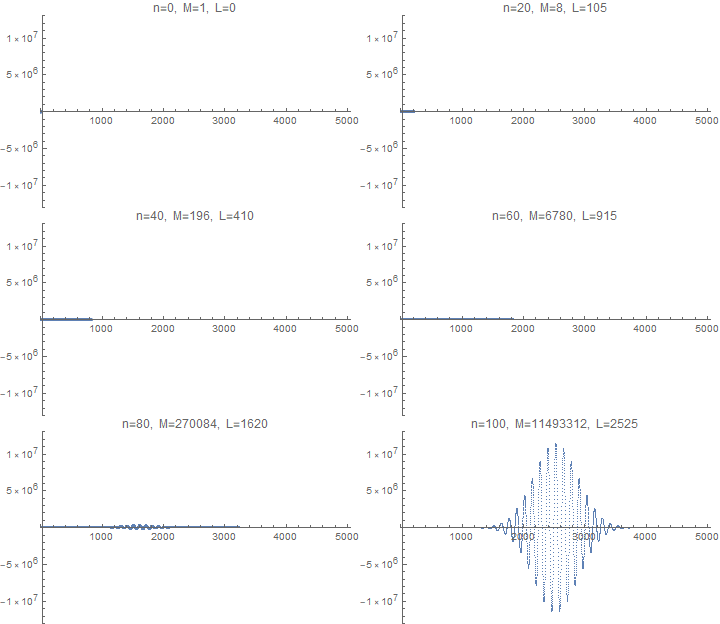
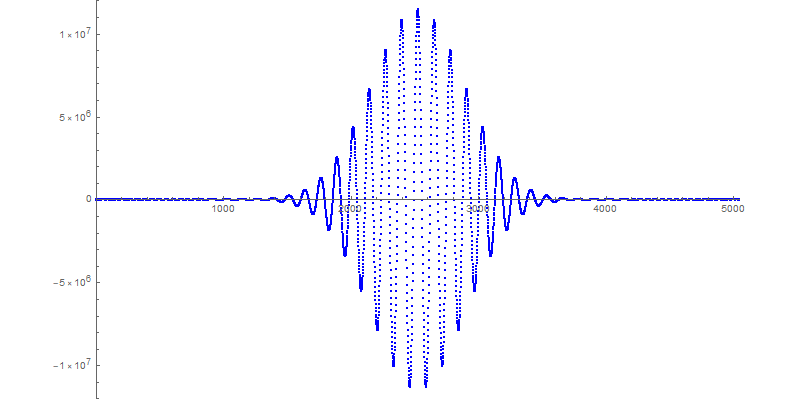
    We can observe how fast these coefficients grow with the following animation where we plot (i, a_{i,n}) from n=0 to n=100 in steps of 5. On the top of the image, you can also see the Maximum Absolute Coefficient (denoted as M) and the first location at which this coefficient appears (denoted by L).

    At n=100, this polynomial has 5051 terms, about 1/3 of which are huge and all around the place! The maximum absolute coefficient at n=10 is 3. This becomes 11,493,312 when we reach n=100. They grow really fast; just as Sudler discovered.

    Whenever we have a list of integers, it is a good idea to check the On-line Encyclopedia of Integer Sequences. We already had the absolute maximum coefficients (Ms) of (q;q)_n for n\leq 50 for our 2017 paper, so we made a quick search of this sequence only to find that this sequence was already listed* and our main question-to-be was right in front of us in the comments.

    This is how the website looked in 2019:

    The comment is clear. People believe that the absolute maximum coefficient of (q;q)_n appears at the midpoint if n is even (I haven’t seen a proof of this, please contact me if you find one) and it is a mystery if n is odd. Berkovich and I studied these locations by calculating all the (q;q)_n for n\leq 75,000. With that, now, we have confirmed the even index belief all the way up to 75,000 and we actually have a conjectural answer to the location question for the odd cases too. There are so many interesting properties of this elusive location that we supposedly found, but this is not the place to discuss those. I suggest checking the article.

    The calculation of these polynomials one by one, finding the maximum absolute coefficient and its location was a huge task. We started calculating (q;q)_ns on Maple, which gave up around n=10,000. We moved to Mathematica and a larger server at Research Institute for Symbolic Computation (RISC) and we got stuck around n=15,000. So I abandoned all the computer algebra systems and started programming in Python and later in C++. Carrying out these calculations correctly is/was not an easy task. I doubt it will ever be in my lifetime. After using all the symmetries and simplifications, one still needs at least \lceil n(n+1)/4 \rceil operations to calculate (q;q)_{n+1} from (q;q;)_n. There is no way of splitting the data. The numbers are growing exponentially and each calculation needed to be carried with arbitrary precision. RISC IT Ralf Wahner dealt with all my incompetence on the RISC side. I need to thank him a lot.

    I attended a presentation by Wolfgang Schreiner on the MACH2 massively parallel shared-memory supercomputer project while I was struggling to make progress in my calculations. Using MACH2 was clearly what I needed. My calculations were already crashing computers with 1.5 Tb Ram at RISC. It would have been a great challenge to crash a computer with 20 Tb of shared Ram (I did crash a 10 Tb section of MACH2 once, so I can rest happily).

    I contacted the MACH2 team, got an account, and gave a brief explanation of what I wanted to calculate. After a couple of emails, Johann Messner and I met in person and went through my code, line by line. I took his feedback and suggestions and started working on those. In the meantime, he started running tests with then-code. It took so much back and forth. Johann kept on asking me to parallelize my code but I didn’t want to do that in order to save used memory. I resisted as much as I can but he won. He knew the MACH2 beast the most after all. Also, he made the great point that MACH2 has slow processors but it has tons of memory at our disposal.

    I didn’t know how to parallelize anything in C++ so I put it on the backburner. It was already more than a year at this point since we first started. The project could have easily sat for another couple of months… and it did. Later in the year, at a conference, I accidentally learned how to parallelize my code from a couple of numerical analysis postdocs. All of a sudden the missing link was there. After Johann’s okay, we cranked the last portion of the calculations (with lots of intermediate checks) from n=40,000 to n =75,000. It still took 3 months even though we were using a little more than 200 cores and 10 Tb of memory.

    The mathematical claims of the article came after all these crazy calculations. I came together with Prof. Berkovich at the University of Florida in October 2019. We compiled the data, looked at it left and right. In a short time, we made the best claims we can make about the elusive location. While we were at it, we refined Sudler’s growth constants as well. This ended my first 2 year-long experimental math project.

    Long story short, the mathematical claims I made stand on the shoulders of many computers, so much wasted electricity, many sleepless nights, and the input of many people many of which haven’t even been mentioned here.

    If you’d like to confirm or disprove that of the maximum absolute coefficient when n=5,050,029 appears as the coefficient of the q^{6,375,697,892,084} term, be my guest. 🙂

    I shared this work with some audiences:
    1. Austrian High-Performance Computing Meeting 2020, IST Austria, Klagenfurt AUT. February 19, 2020
      Where do the maximum absolute q-series coefficients of (1-q)(1-q^2)...(1-q^{n-1})(1-q^n) occur? (Slides)
    2. The 85th Seminaire Lotharingien de Combinatoire, Strobl AUT. September 6, 2020
      Where do the maximum absolute q-series coefficients of (1-q)(1-q^2)...(1-q^{n-1})(1-q^n) occur?
    3. Hudson Colloquium, Georgia Southern University, Savannah GA. September 23, 2020 (Online Meeting)
      Where do the maximum absolute q-series coefficients of (1-q)(1-q^2)...(1-q^{n-1})(1-q^n) occur? (Pdf)
    Of course there are some simple typos here and there in the article, let me address the ones I know about here:
    1. There are two 68,324s written by accident. Those should be 62,624s as in everywhere else in the paper.
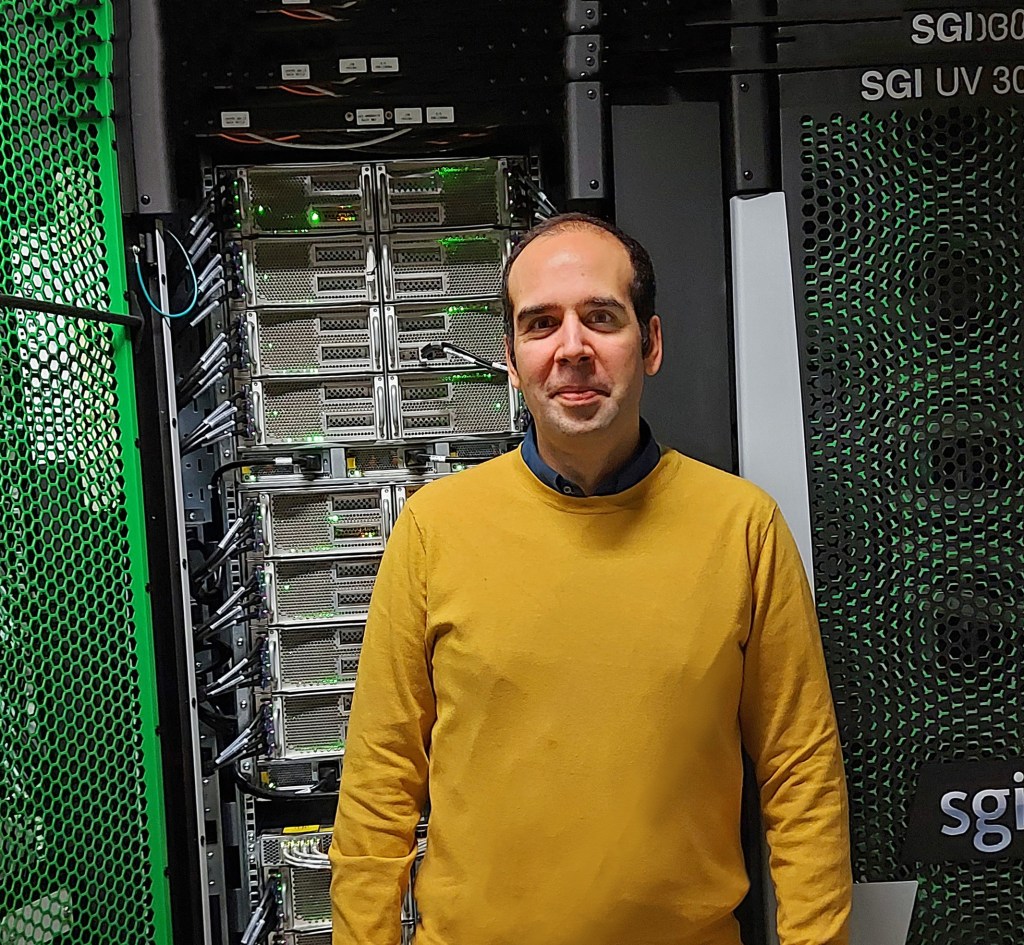
    MACH2 and I at JKU Server Room in 2023
  • 15 minute mathematics advice /w Wadim Zudilin

    Wadim is a great matematician and a great inspiration. I am lucky to know him. He is always enthusiastic about mathematics and full of new ideas.

    In this chat I tried to get some insight of what he likes so much about this field. I hope you’ll enjoy.

  • 15 minute mathematics advice /w Christian Krattenthaler

    Another amazing researcher with an incredible list of accomplishments. I caught him at the SLC 85 conference and had a nice chat. I think we need a second part of this interview because I couldn’t even cover half the topics I’d like to.

    I know Christian for a number of years now, and wanted to interview him in this series. I was too shy to ask for some reason… so I thank Wadim for actually being the instigator.

    I hope that you will enjoy this video.

  • AMS Special Session on Experimental and Computer Assisted Mathematics

    Joint Mathematics Meetings 2020, Denver CO

    Here is the pdf version.

     
    I love the Joint Mathematics Meetings. I was fortunate to be invited for these meetings 5 times so far and I get to be there for 4 of these events. For me it is a meeting point to come together with friends and (mathematics) family. I cannot count the number of times that I have seen an inspirational talk or accidentally have run into someone that I was longing to see in these meetings. I can characterize these meetings as huge, disorienting, and sometimes too much but over all this is an event I wouldn’t want to miss.
     
    In a conversation much earlier than JMM 2020, Chris Jennings-Shaffer (Univ. Denver) mentioned how he was applying for a special session at this event. He was already at the conference location and it was making much sense. He suggested that I should also think about applying for one too. It was a well timed suggestion. I wanted to organize something for more than a year but I was always second guessing myself about whether I will be invited to give a talk, take the over Atlantic trip, etc. By this time, I also had some experience in organizing conferences and workshops therefore applying for a special session, where I only need to find speakers didn’t sound bad. We figured that there will be a q-series/partition theory session and a number theory session. If Chris could get his session, that would make it a second q-series/number theory session. I just wanted to advertise a seemingly non-overlapping topic.
     
    From the get-go, I know I wanted to have a different session, one that has a mix of combinatorics and q-series researchers. These two fields have too much in common but somehow don’t get to mingle in general. This was the case in Turkey. This was the case in University of Florida. This was the case in the conferences I have attended. One exception to this informal segregation was RISC/RICAM, Linz Austria, where I was doing my postdoc. I know I learned a lot from the diverse research environment. The Austrian Science Fund’s (FWF) special research project (SFB F50) consists of 12 mixed projects, where combinatorics, q-series, number theory and symbolic computation are mixed and encouraged to come up with solutions together. I joined this group with a pinhole view of what my research area was, and learned that it was touching much more. That was the goal for the special session too. I wanted people to see some related “unrelated” research.
     
    I settled on experimental mathematics as my session subject early on as its definition is open to interpretation. The next big thing was to find a co-organizer that I would like to work with. Thankfully there are many names. Honestly, I figured that applying with someone from an American university would raise the chances. I had no connection with AMS at the moment after all. Shashank Kanade (Univ. Denver) and Matthew Russell (Rutgers Univ.) was a natural duo to approach. They are dear friends before anything, and great researchers that are known for their experimental mathematics publications on top of all the other things they accomplished. Mind you, these are busy people that are also in high demand. Shashank already was organizing/applying for another session and speaking in another, Matthew was busy with his institutional duties. Thankfully it didn’t take much convincing to organize a session together.
     
    We submitted our request to AMS JMM board after a short discussion about the scope and the vision of what our session should be. It must have been a nightmare for the JMM board to decide who gets what because they took about an extra month and a half to decide on the schedule and the special sessions. We got our session. It was official scheduled for 5 uninterrupted hours on the second half of the last day of the conference. It was great news regardless. Not surprisingly all our earlier guesses with Chris was realized too. He got his session. Shashank also got his other session. There were partition theory and number theory sessions too. It was great news all around, there were going to be so much to learn and so many people to see. Just the way I hoped for.
     
    By then, it was clear that Matthew was going to be quite busy and he was not going to be able to join JMM. Shashank and I sent out our invitations and build up a nice mixture of everything. It was certainly much better than I initially planned. From number theory to machine learning and from automated/computerized provers to combinatorics, we had everything. The funny thing is, although many people turned down our invitation in the process, the session filled really quickly and it now feels like we could have easily filled another 5 hours with just as great speakers (I have to admit, I remember us being slightly worried about being able to fill the session back then). Maybe in another JMM in future.
     
    The session averaged 30 people per talk. In a conference which attracts more than 5000 mathematicians a year, this may sound like a small number. In perspective, the special session was actually a hit. The mathematician swarm of downtown Denver was releasing that day, conference attendees were vacating their hotels and heading towards the airport. Even under these circumstances there were 42 other conference events scheduled at the last afternoon of the conference. Still including some really nice research sessions with overlapping research topics with our experimental mathematics session. Our session was one of them. Shashank’s other session was one of these too. He needed to juggle and, I can only imagine, got some decent exercise between two seminar rooms.
     
    Kate Stange, technically a local, opened our session with the demonstration of the project Numberscope, where we were bombarded with many nice visualisations of Diophantine equations related questions. Then Zafeirakis Zafeirakopoulos and William Severa presented machine leearning approaches to nowadays problems and a glimpse of DOE’s research in lowering the energy consumption of high performance calculations. Petr Vojtěchovský, this time definitely a local, talked about his research on universal algebras and the automated prover implementation Prover9 and its strengths in finding and writing out proofs with certificates for some algebra problems. The session followed with number theory. Jakob Ablinger and Michael Mossinghoff presented new computer generated and proven identities involving Riemann zeta value  and experimental observations about divisor sums related constants and problems, respectively. Then we saw an elementary constructive approach to finding extremal values of the statistics related to hypercube orientations as directed graphs with maximal or minimal number of special nodes. We then reached my comfort zone, q-series portion of the session. Drew Sills presented his postdoc project RRtools package that he implemented in Maple and finite Rogers–Ramanujan type identities. He suggested some future research directions, which I am working on to this day. Then Chris Jennings-Shaffer, another local to the conference, presented the proofs of  Kanade-Russell (do these names look familiar?) mod 12 conjectures he found with Kathrin Bringmann and Karl Mahlburg. It still amazes me how a simple guess and prove approach and heavy computer use cracked these conjectures. We closed the session with Frank Garvan, and his new results on the mod powers of 5 and 7 congruences for the rank and crank functions.
     
    Exchanging pleasantries and goodbyes with the participants at the end of the conference always takes some extra time. The conference room kept being filled with nice friendly chat and occasional laughter until a convention center employee politely kicked us out. Carrying our conversations to the convention center aisles was nothing new to us of course. This just meant it was closing to dinner time with friends before saying our final goodbyes of the conference. We ended up going to a local diner. It was the first chance from the beginning of this 4 day, 5 day conference I had with Shashank to do some actual catching up, which was great.
     
    Maybe this is the only downcast of the conference. It is always a cheerful reunion but there is no time to catch up with everyone. Oh well… I bet I am not the only one feeling that way.
     
    DSC05459-Edit
    Proud organizers at the end of the session
     

  • 15 minute mathematics advice /w Alexander Berkovich

    My own advisor! I have learned a lot from him. He is my biggest collaborator, an amazing theoretical physicist turned mathematician. It is a privilege to know him and definitely a great feeling to be sharing some of his wisdom with you all.

    I hope that you will enjoy this video.


  • 15 minute mathematics advice /w Marc Chamberland

    Here is the face behind the TippingPointMath. Not only he is a great narrator and communicator of math, Marc is also a serious and active researcher. I hope you’ll enjoy our conversation.


  • 15 minute mathematics advice /w Murali Rao

    Always smiling, one of the amazing professors of UF. I had great fun chatting with Prof Rao.


  • 15 minute mathematics advice /w Sara Pollock

    A new addition to the UF Mathematics department, and a new friend. I had a great chat with Sara.


  • 15 minute mathematics advice /w Kwai-Lee Chui

    Mrs Chui is an amazing University of Florida lecturer.She is loved and well respected in UF. Not to forget that she is powerhouse when it comes to her teaching; teaching around a 1000 in a semester.

    She is the one lecturer I did most of my teaching with in my UF time. We have created the Online Calculus II lectures for UF together. Turns out it is still our infrastructure and still our faces, that are teaching the online students since the FALL 2014.


    We talked about how the education is changed, how the increasing numbers create more paperwork and sometimes take the fun out of teaching, how I missed teaching with her, etc. Hope you enjoy it.